The Infinity Pool as Architecture: How Ultra-Luxury Homes Turned Water Into the Ultimate Design Statement
March 17, 2026 · 14 min read
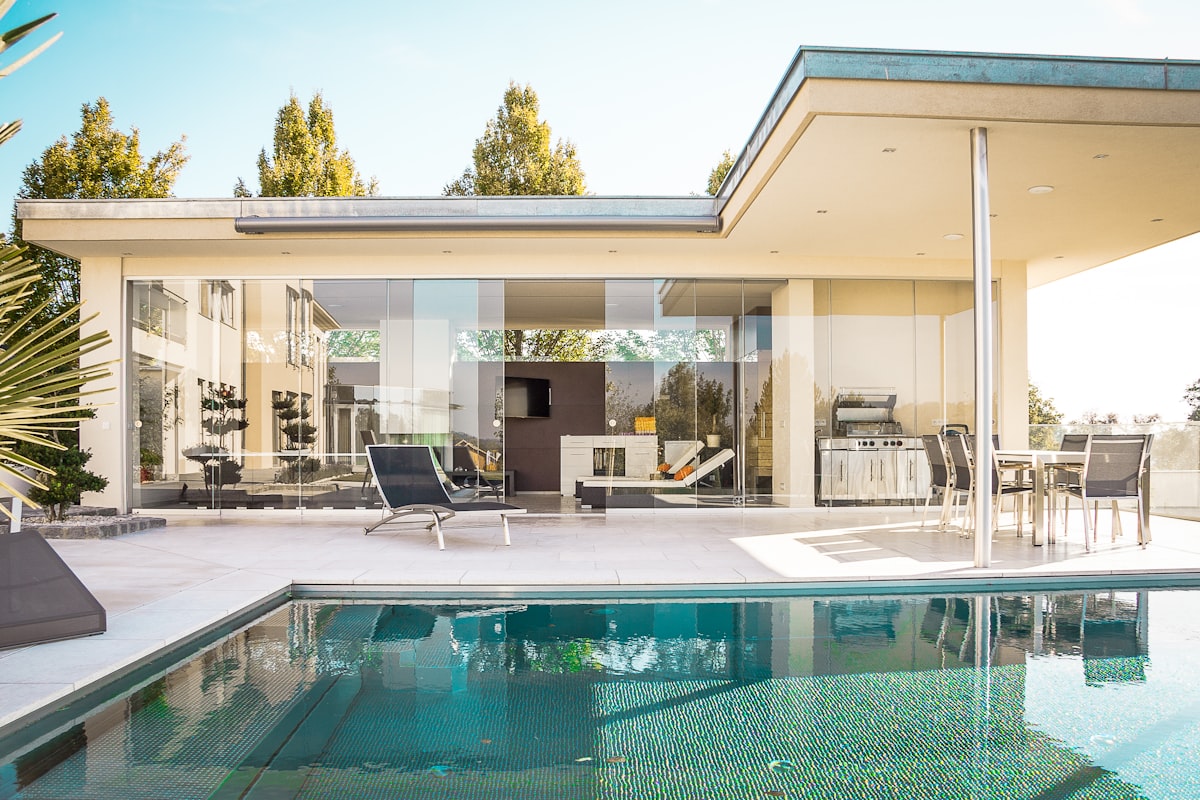
The most expensive single element in a €50 million villa is almost never the kitchen, the home cinema, or the wine cellar. It is the pool. Not the rectangular lap pool of suburban aspiration — that can be built for €150,000 anywhere on the planet — but the architectural pool: the vanishing-edge infinity that appears to pour into the Mediterranean, the rooftop mirror pool that reflects the sky and dissolves the boundary between residence and atmosphere, the subterranean grotto carved from living rock with underwater lighting that transforms a basement into a bioluminescent cave. These are not amenities. They are buildings within buildings — feats of structural engineering, hydraulic design, and material science that can cost €3-8 million and take eighteen months to construct. And they have become, in the second quarter of the twenty-first century, the single most important status marker in ultra-luxury residential architecture.
The Invention of the Vanishing Edge
The infinity pool — more properly, the negative-edge or vanishing-edge pool — was not invented for luxury. Its origin is functional: French architect and landscape designer Jean-Claude Nicolas Forestier developed the concept in the early twentieth century for agricultural irrigation basins in Morocco, where water needed to overflow evenly across a flat edge to feed terraced fields below. The aesthetic potential was recognised decades later by John Lautner, the visionary Los Angeles architect whose Silvertop residence (1957) featured a pool that appeared to spill over the edge of a Silver Lake hillside. Lautner understood something that would take the luxury market forty years to fully grasp: that a pool's primary function is not swimming. It is the manipulation of visual space — the illusion that a finite body of water extends infinitely into the landscape beyond.
The concept reached its definitive expression in the 1990s, when a generation of Balinese resort architects — most notably Kerry Hill, whose Amanusa resort (1992) featured an infinity pool that merged with the Indian Ocean horizon — demonstrated that the vanishing edge could transform any elevated site into a transcendent experience. The hotel industry adopted the concept with evangelical fervour. By 2000, an infinity pool was a prerequisite for any resort aspiring to five-star status. By 2010, the technology and engineering knowledge had filtered down (or up, depending on your perspective) to the residential market, where it met an ultra-luxury buyer class increasingly fixated on experiential architecture — on homes that didn't just contain their owners' lives but actively shaped their sensory experience of the world.
Engineering the Impossible
The structural engineering of a modern architectural pool is formidably complex. Water weighs approximately one tonne per cubic metre. A typical ultra-luxury infinity pool holds between 80 and 200 cubic metres — meaning that the pool structure must support, in addition to its own weight, between 80 and 200 tonnes of water in a configuration that, by definition, pushes that water toward an open edge. The engineering challenge is not merely structural but dynamic: water in an infinity pool is in constant motion, flowing over the vanishing edge into a catch basin below, from which it is pumped back into the main pool. This creates forces — hydraulic pressure, vibration, thermal expansion and contraction — that traditional pool engineering was never designed to accommodate.
The solution, developed incrementally by specialist firms like Myrtha Pools (Italy), Bradford Products (USA), and Piscines Magiline (France), involves stainless-steel monocoque construction: the pool is fabricated as a single welded steel shell, engineered to the tolerances of a marine vessel rather than a building component. The steel — typically 316L marine-grade stainless — provides corrosion resistance, structural rigidity, and a surface finish that can be polished to a mirror or brushed to a matte texture. A single monocoque infinity pool of 25 metres, with a vanishing edge and integrated spa, weighs approximately 15 tonnes empty and requires a structural support system — typically reinforced concrete piles or a steel subframe — that adds another €500,000-1,000,000 to the project cost.
The Rooftop Revolution
The most dramatic evolution in architectural pool design is the migration upward. Rooftop pools — once the exclusive province of hotels and penthouses — are increasingly appearing atop private residences, where they function simultaneously as pools, green roofs, and architectural crowning elements. The engineering challenges are extreme: a rooftop pool adds between 100 and 300 tonnes of dead load to a building's structure, requires waterproofing systems that must perform flawlessly for fifty years (a leak from a rooftop pool is not a nuisance but a structural emergency), and must accommodate thermal movement — the expansion and contraction that occurs when a black-tiled pool absorbs solar radiation on a Mediterranean summer afternoon and then cools overnight.
The rewards, however, are extraordinary. A rooftop pool eliminates the traditional compromise between pool and garden: the garden occupies the ground level, the pool occupies the roof, and the living spaces in between enjoy unobstructed views in both directions. The water surface, elevated above the surrounding landscape, reflects the sky and creates a light quality within the house that ground-level pools cannot match — a shimmering, aqueous illumination that moves across ceilings and walls with the rhythm of the wind. Architects describe this as "living with water above you" — a spatial inversion that feels simultaneously luxurious and primal, recalling the experience of swimming beneath a waterfall or diving beneath the surface of a lake and looking up at the sunlight filtering through.
The Subterranean Grotto
At the opposite extreme, the basement pool — or more precisely, the subterranean grotto — has emerged as the ultimate expression of private luxury. Freed from the constraints of climate, views, and structural exposure, the basement pool exists in a controlled environment where temperature, humidity, lighting, and acoustics can be precisely calibrated. The best examples are not pools in basements but basements reconceived as aquatic environments: spaces where stone walls, indirect lighting, steam, and the sound of water create an atmosphere that references the thermal baths of ancient Rome, the hammams of the Ottoman Empire, or the natural grottos of the Amalfi Coast.
London's super-prime market has become the global leader in subterranean pool design, driven by planning restrictions that limit above-ground construction but permit extensive basement excavation. Iceberg houses — properties where the underground volume exceeds the above-ground footprint — routinely include pools of extraordinary ambition. A recent Knightsbridge project by Finchatton includes a 20-metre pool with a retractable floor (which rises hydraulically to create a flat surface for entertaining), a cold plunge pool carved into Portland stone, a hammam clad in zellige tiles imported from Fez, and a sauna with floor-to-ceiling windows that look into the pool through underwater glass — a theatrical inversion that places the sauna user inside the aquarium rather than outside it. The total cost of the aquatic suite: £4.2 million.
Materials and the Pursuit of Texture
The material palette of the architectural pool has expanded dramatically beyond the blue mosaic tile that defined the twentieth-century swimming pool. Black basalt — which gives water a reflective, mirror-like quality — has become the signature material of minimalist pool design, favoured by architects like John Pawson and Vincent Van Duysen. Green sukabumi stone, a volcanic mineral from Java, produces the jade-green water colour seen in the world's most photographed resort pools and is now specified in residential projects across the Mediterranean and Gulf. Travertine — particularly the silver-grey variety from Tivoli — is used for pool surrounds and copings, where its naturally non-slip surface and ability to remain cool underfoot combine practical and aesthetic functions.
The most avant-garde material choice is glass. Structural glass pools — where one or more walls are replaced by transparent panels — create the vertigo-inducing effect of swimming in mid-air. The technology, pioneered by Reynolds Polymer Technology, uses laminated acrylic panels up to 300mm thick that are optically clear, structurally rated to contain the hydraulic pressure of the pool, and UV-stable to prevent yellowing over decades of sun exposure. The cost is exceptional — a single glass wall panel for a 15-metre pool can exceed €800,000 — but the visual effect is unmatched. From outside, the pool becomes a living aquarium; from inside, the swimmer is suspended in a transparent volume with unobstructed views of the landscape below.
Sustainability and the New Pool Ethics
The environmental profile of the ultra-luxury pool has undergone a quiet revolution. Heated pools in Mediterranean climates historically consumed 15,000-25,000 kWh of energy annually — equivalent to the total consumption of a small European apartment. The current generation of pool technology has reduced this by 60-80% through a combination of variable-speed pumps (which consume a fraction of the energy of traditional single-speed models), air-source heat pumps (which extract thermal energy from ambient air with a coefficient of performance of 5:1 or better), solar thermal covers (transparent floating panels that heat the pool passively during the day and retain heat overnight), and natural filtration systems (planted regeneration zones that clean the water biologically, eliminating the need for chemical treatment).
The natural pool — or swimming pond, as it is known in the German-speaking world where the concept originated — represents the philosophical endpoint of this evolution. A natural pool uses no chemicals whatsoever: water is circulated through a planted regeneration zone (typically 30-50% of the total water surface area) where aquatic plants and beneficial bacteria remove contaminants biologically. The result is water of extraordinary clarity and softness — water that feels alive on the skin, that smells of rain rather than chlorine, that supports dragonflies and frogs at its margins. The aesthetic is radically different from the controlled perfection of a conventional pool: it is deliberately, beautifully imperfect, and it speaks to a generation of ultra-luxury buyers for whom environmental consciousness is not a compromise but a value.
The pool has completed its journey from utility to architecture. What was once an amenity to be added to a house has become the element around which the house is conceived — the point where engineering, aesthetics, and the primal human relationship with water converge into something that transcends all three.